Red Bud Isle to Laguna Gloria: Where Wild West Austin Meets Curated West Austin
August 20, 2026
August 20, 2026
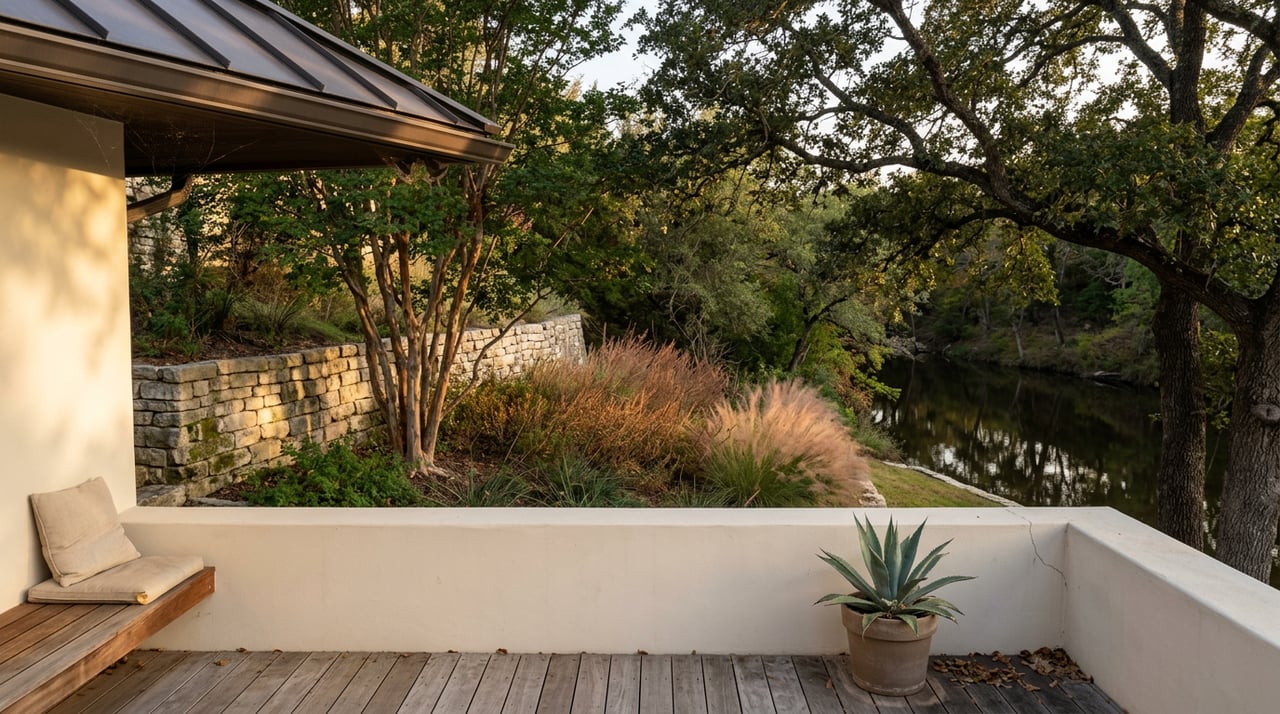
The walk from the parking lot at Red Bud Isle to the front gate of Laguna Gloria is mostly uphill, none of it requiring a car. Along the way you pass through three distinct versions of West Austin: an unmanaged stretch of lake that the city is actively experimenting on this year, a fenced 23-acre bird sanctuary whose residents keep escaping into the surrounding blocks, and a professionally curated sculpture park that just unveiled its most ambitious outdoor commission in recent memory. Most people who live near this corridor have done pieces of this walk a hundred times without noticing that the rules change completely from one stop to the next. This is the summer to notice.
Red Bud Isle sits just below the Tom Miller Dam, and every summer since 2019 it has been ground zero for Austin's blue-green algae problem. The mats show up as dark, slimy blobs along the shoreline, mostly between late May and early August, which puts us right at the tail end of this year's typical window. Austin Watershed Protection has already confirmed thick mats near Red Bud Isle on Lady Bird Lake and at Walsh Boat Landing on Lake Austin this year, and the advice hasn't changed: keep dogs away from anything that looks like scum or floating debris, don't let pets in if it's rained in the past three days, and rinse animals off before they can lick their fur.
What is different in 2026 is the city's own approach. For five straight years, contractors applied lanthanum-modified clay to the lakebed at Red Bud Isle and a few other sites, a $1.5 million effort to manage the phosphorus the algae feeds on. This year is a deliberate control year. No clay is going down. City officials want a clean read on whether the treatment actually worked before deciding whether to keep funding it at the same level. If you've walked past Red Bud this summer and thought the water looked about the same as always, that's not your imagination. It's the point.
For regulars, this means the usual habit of glancing at the shoreline before letting a dog off leash isn't just caution, it's participating in a live policy question the city is still trying to answer.
A short drive north on Mount Bonnell Road gets you to Covert Park, home of Mount Bonnell, one of the highest points in the city at just over 775 feet. The Covert family donated the land to the city back in 1939, and almost nothing about the visit has changed since. The trail is short, measured at roughly a third of a mile by the city's own trail directory, but the ascent is fixed: 102 stone steps, no ramp, no accessible route, open daily from 5 a.m. to 10 p.m. and not a minute later.
The contrast with Red Bud Isle is worth sitting with. Down at the lake, the rules are informal and the risk is real but self-managed. You decide whether the water looks safe. Up at Mount Bonnell, the rules are rigid and the danger is mostly logistical: a stroller won't make the climb, there's no shade at the summit, and posted police advice for the lot centers on locking doors and keeping valuables out of sight, which is why regulars know to leave nothing visible in the car. Both spots are free. Both are technically low-effort. Neither behaves the way the other one does.
A short walk from the Mount Bonnell parking area sits Mayfield Park, a 23-acre preserve built around a cottage that Allison Mayfield bought in 1909 as a family retreat. His daughter Mary Frances and her husband Milton Gutsch expanded the gardens through the following decades, and when Mary Frances willed the property to the city in 1971, the peacocks the Gutsches had been gifted back in 1937 came with it. Nearly nine decades later, they're still the reason most people visit.
This spring, KXAN reported that some of those peacocks stopped staying put. A city park volunteer confirmed that at least four birds had been dumped at Mayfield, not born there, and by April they were showing up on porches well outside the park boundary, including a home on Bowman Avenue and a yard near the Austin Public Library's Howson Branch. Neighbors filmed peahens lounging at their front doors. It's a small story, but it says something real about this stretch of the city: even the most deliberately fenced, historically maintained piece of nature here doesn't fully hold its line. The park has rules against feeding, touching, or chasing the birds precisely because they're supposed to stay wild enough to survive on their own, and this year that same wildness sent a few of them wandering.
Follow the same cul-de-sac past Mayfield and you reach Laguna Gloria, the lakeside campus of The Contemporary Austin. This is where the loop stops feeling improvised. Admission is charged except on Thursdays, when the grounds and the Betty and Edward Marcus Sculpture Park are free to walk. The museum's newest addition is HOST: Laura Lit, the Austin-based artist's first solo museum exhibition and her debut outdoor installation, extending the museum's programming from its indoor Jones Center space out onto the sculpture park grounds for the first time in this form. Lit works across figurative painting, special-effects makeup, and architectural restoration, and the piece reflects that range. The museum also has a free family event called Arty Party: Mail! on the calendar for Friday, August 28, part of its ongoing kids and family programming at the Laguna Gloria grounds.
Laguna Gloria sits on fourteen acres of Lake Austin, not Lady Bird Lake, and that distinction is the whole point. The Tom Miller Dam you passed at the start of the walk is the line where one becomes the other. Below it, at Red Bud Isle, you're on Lady Bird Lake, where the city is mid-experiment on algae and nobody is charging admission to look at the water. Above it, at Laguna Gloria, you're on Lake Austin, where the same river shows up dressed for a museum. The corridor doesn't just change management style as you climb the hill. It crosses into a different named body of water, at almost exactly the halfway point.
Every stop on this walk touches the same river and sits within a few hundred yards of the next, yet each one runs on a completely different set of rules: a lake the city is actively experimenting on, a summit governed by fixed hours and a fixed staircase, a bird sanctuary that can't quite keep its residents inside the fence, and a curated art campus that charges admission six days a week. For anyone who has lived near this corridor long enough to stop noticing the differences, this particular summer is handing over three separate, dated reasons to look again: a control-year experiment at the water, an escaped flock that made the local news, and a brand-new outdoor installation at the top of the hill.
If you're mapping out a Saturday around it, the order that tends to work best is simple:
None of this requires planning a move or comparing listings. It's just the loop this part of the city has been running for years, with a few more moving pieces in it than usual right now.
If you're already living in this stretch of West Austin and questions ever turn from where to walk this weekend to what your home might be worth in this market, the Ruth & Evonne Team knows this corridor block by block, from the lake rules to the ones at the top of the hill. Reach out anytime for a conversation, no pressure attached.
Stay up to date on the latest real estate trends.
November 19, 2026
November 12, 2026
November 5, 2026
October 29, 2026
October 22, 2026
October 15, 2026
October 8, 2026
October 1, 2026
September 24, 2026